Albert Bierstadt (January 7, 1830 – February 18, 1902), known for his large-scale romanticized landscapes of the American West, was born in Germany but immigrated to Massachusetts shortly afterward. Largely self-taught, Bierstadt attended an informal art school in Dusseldorf, Germany, to refine his technical skills. While in Europe, Bierstadt painted Alpine landscapes. When he returned to America, Bierstadt worked on survey expeditions throughout the 1860s and 1870s, travelling across the West and Canada. He took photos and made field sketches as references which he used while painting in his New York studio. His paintings were popular in Europe, even garnering attention from Queen Victoria in 1867 and prompting immigration to the US; however, Bierstadt’s paintings were also criticized as overly dramatic with their bright lighting. Thus, his work fell out of style until it was rediscovered in the 1960s. Over his career, Bierstadt painted over 500 works, which are now held in collections such as the National Gallery of Art in Washington, D.C.; the Metropolitan Museum of Art, New York; and the Timken Museum of Art, San Diego.
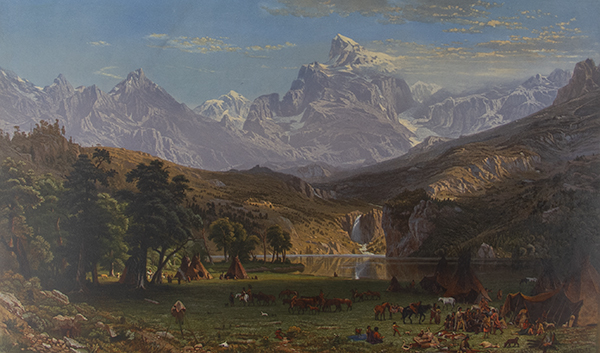
Artist: Albert Bierstadt
Date: 1863
Edition: N.E
Medium: Lithograph
Collection: Fine Art
Copyright Status: Public Domain
Accession Number: 1978.0022.0001