John James Audubon (April 26, 1785 – January 27, 1851) was an ornithologist, artist, naturalist, adventurer, and story teller. Born in San Domingue (now Haiti), Audubon began studying birds, nature, and art after moving to France at the age of five. His studies continued near Philadelphia, when he was sent to a family estate at eighteen. While there, Audubon is said to have conducted the first bird-banding experiment, tying strings to the legs of birds to determine whether they return to the same nesting sites each year. He spent the early 1820s drawing birds in Mississippi, Alabama, Florida, and Louisiana before taking his Birds of America portfolio containing over 400 life-size drawings to England and Scotland for printing. His work was very well received, even gaining a subscriber in King George IV. Audubon’s work was highly praised since it was more natural than previous artists’ renditions. He continued drawing new species for the rest of his life, but later volumes were mostly completed by his sons. As one of the forefathers of the modern conservation and environmentalist movements, many organizations and places bear Audubon’s name. His works are housed in such collections as the National Gallery of Art, Washington, D.C.; the Harvard Library; and the Library of Congress.
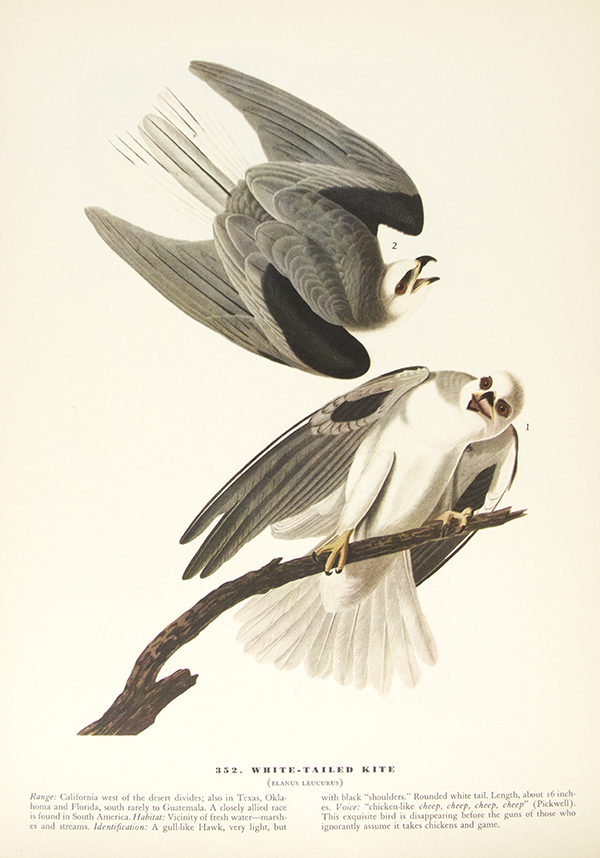
Artist: John James Audubon
Date: 1937 c.
Medium: Reproductions
Collection: Fine Art
Dimensions: H. 12.5 x L. 9
Copyright Status: Public Domain
Credit: Gift of Louise Kelly
Accession Number: 1968.0019.0085